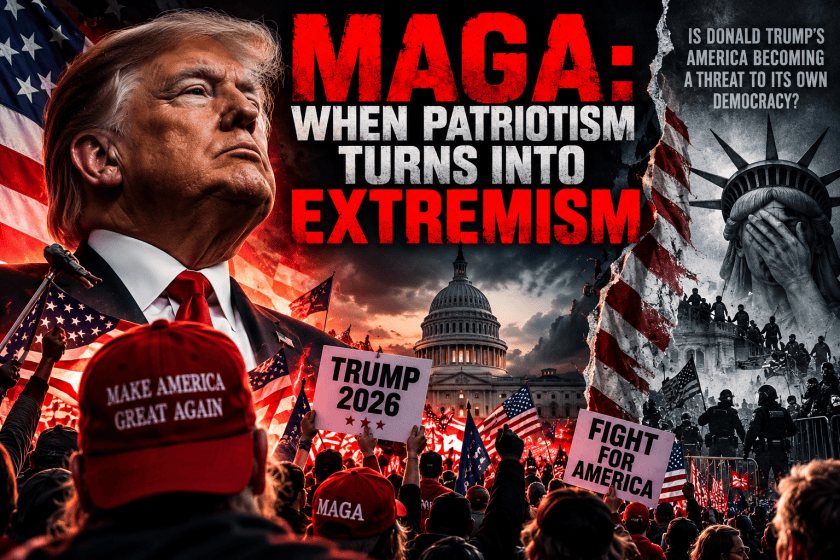
Donald Trump, Political Radicalization and the Dangerous Future of American Democracy
October 21, 2026 | Politics, Democracy & World Affairs
Written by Jessy Unknown
Make America Great Again — But Great for Whom?
America was built on a revolutionary idea: freedom.
Freedom of speech. Freedom of religion. Freedom to disagree with those in power.
But today, something deeply troubling is happening inside the world’s most influential democracy.
The MAGA movement, built around Donald Trump’s promise to Make America Great Again, has become much more than a political slogan.
For millions, it represents patriotism, national pride, border security and frustration with Washington’s political establishment.
But within its more radical circles, something darker has emerged.
Political opponents are treated as enemies. Compromise is portrayed as weakness. Loyalty to one political leader can appear more important than loyalty to democratic principles.
When does patriotism stop being love for your country and start becoming unconditional obedience to a leader?
That is the question America can no longer afford to ignore.
The Cult of Political Loyalty
Donald Trump has transformed American politics.
His supporters often describe him as the only person willing to confront a corrupt political establishment.
His critics see a leader who has systematically weakened trust in elections, independent institutions and traditional democratic norms.
The disturbing question is not whether people have the right to support Trump.
Of course they do.
The question is what happens when a political movement begins treating its leader as someone who cannot be questioned.
Democracy requires disagreement.
It requires independent courts, a free press and the possibility that your preferred candidate might lose an election.
A democracy cannot survive if accepting defeat becomes optional.
No president should be treated as a king.
And no political party should become a personal loyalty test.
The Warning Signs Are Already Here
The concerns surrounding American democracy are no longer limited to political commentators.
In October 2026, the Journal of Democracy published research describing the United States as having moved toward competitive authoritarianism — a political system where elections continue to exist but democratic competition becomes increasingly unequal.
Meanwhile, the Brennan Center for Justice reported that at least 34 federal district court decisions had blocked or halted Trump administration efforts involving election rules and administration.
These legal disputes reveal an increasingly intense struggle over who controls the democratic process.
Trump’s administration argues that its election policies are intended to strengthen integrity and prevent fraud.
Critics argue that some measures threaten voting rights and exceed presidential authority.
But the underlying principle should be non-negotiable:
The government should not get to rewrite the rules simply because it fears losing power.
Political Violence: When Words Become Dangerous
One of the most alarming aspects of American political polarization is the growing acceptance of extreme rhetoric.
When political opponents are repeatedly described as enemies, traitors or existential threats, democratic disagreement becomes something much more dangerous.
Research from the University of California, Davis, found that MAGA-aligned Republicans were more likely than several other political groups to justify political violence under certain circumstances.
Yet the same research also revealed something important: the overwhelming majority of Americans, including MAGA supporters, do not express a willingness to commit political violence.
That distinction matters.
Not every Trump supporter is an extremist.
Not every conservative supports authoritarianism.
And political violence is not exclusive to the American right.
But extremist tendencies within any powerful political movement must be confronted before they become normalized.
The moment violence becomes an acceptable political argument, democracy begins to lose its meaning.
Social Media: The Perfect Machine for Political Anger
Modern political radicalization does not happen only at rallies.
It happens on smartphones.
On social media platforms, political outrage spreads faster than careful analysis.
Algorithms can reward conflict, sensationalism and emotionally charged content.
Conspiracy theories can reach millions before journalists have time to investigate them.
Political identity becomes entertainment.
Anger becomes engagement.
And engagement becomes money.
In such an environment, the loudest voices are not necessarily the most truthful.
They are simply the most profitable.
MAGA’s digital ecosystem demonstrates how effectively a political movement can mobilize supporters through constant confrontation.
But this problem extends far beyond MAGA.
When outrage becomes a business model, political extremism becomes a marketable product.
Is America Moving Toward Authoritarianism?
Authoritarianism rarely announces itself openly.
It can emerge gradually through attacks on independent institutions, pressure on political opponents and the erosion of public trust.
Elections may continue.
Political parties may still exist.
Television debates may still take place.
But the democratic safeguards protecting genuine competition can weaken.
The United States remains a country with independent judges, opposition politicians, civil society organizations and millions of citizens willing to defend constitutional freedoms.
These institutions matter enormously.
Yet their continued existence should not be mistaken for proof that democracy faces no danger.
Freedom House’s 2026 assessment still classified the United States as free, while recording a decline in its democracy and civil-liberties score.
Democracy does not disappear only when elections end. It can also weaken when those in power stop respecting the limits of their authority.
The Dangerous Confusion Between Patriotism and Nationalism
Loving your country is not extremism.
Wanting secure borders is not extremism.
Questioning government policy is not extremism.
And voting for Donald Trump does not automatically make someone a radical.
But patriotism becomes dangerous when it demands unquestioning loyalty, treats minorities as permanent outsiders or portrays political disagreement as betrayal.
A confident nation does not need to silence criticism.
A strong democracy does not need to fear opposition.
And a genuinely patriotic movement should be capable of criticizing its own leaders.
Real patriotism means defending your country’s principles — even when your favorite politician violates them.
The World Is Watching
The political direction of the United States matters far beyond American borders.
American decisions influence NATO, international trade, financial markets, military alliances and global security.
When the world’s most powerful democracy struggles with political extremism, the consequences can reach Europe, Asia and the rest of the world.
For decades, the United States presented itself as a defender of democratic values.
Today, its own political institutions are being tested.
The question is no longer simply whether Donald Trump can maintain control of the Republican Party.
It is whether American democracy can remain stronger than any individual president or political movement.
Final Thought: America Does Not Need a Savior. It Needs Democracy.
Perhaps the most dangerous idea in modern politics is the belief that one extraordinary leader can solve everything.
One man who alone understands the truth.
One man who alone can defeat the enemies.
One man who alone can restore national greatness.
History offers countless warnings about what happens when political movements begin to think this way.
America does not belong to Donald Trump.
It does not belong to the Republican Party.
It does not belong to the Democrats.
It belongs to its people.
And its Constitution exists precisely to ensure that no individual becomes more powerful than the democratic system itself.
A nation is not great because its people obey a leader.
A nation is great because its leaders must answer to the people.
And perhaps that is the lesson America needs to remember before it is too late.
Independent Political Commentary | October 2026
Is MAGA still a patriotic movement, or are its radical elements pushing America toward something far more dangerous?
The future of American democracy deserves an honest debate.


