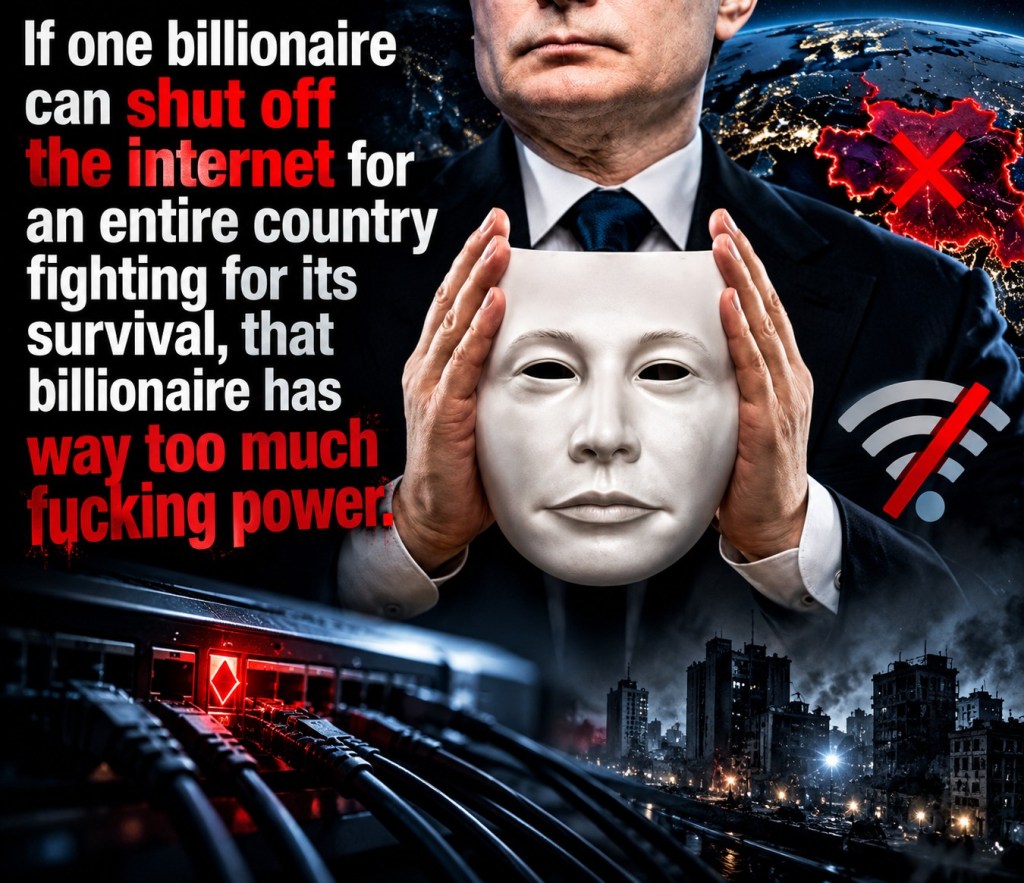
Is Elon Musk Becoming More Powerful Than Governments? The Dangerous Truth About Starlink, Ukraine and Global Control
October 21, 2026 | Technology, World Politics & Global Power
One Billionaire. Thousands of Satellites. Millions of Lives.
Imagine a world where a single businessman can influence military operations, disrupt communications and potentially change the course of a war.
No election. No democratic mandate. No public accountability.
Just technology, money and an extraordinary concentration of power.
Welcome to the age of Elon Musk.
What began as an ambitious project to bring internet access to remote regions has evolved into something far more politically significant.
Starlink is no longer simply an internet service.
It has become a strategic infrastructure system on which governments, military forces and millions of ordinary people depend.
And that raises one deeply uncomfortable question:
Who gave a private billionaire this much power?
Ukraine: When Internet Access Becomes a Weapon of Influence
In October 2026, Starlink once again became the center of international controversy.
Ukraine reported restrictions affecting its military satellite communications, including drone operations used for both attacks and air defense.
According to reports published by Reuters and The Wall Street Journal, Elon Musk allegedly ordered restrictions on the military-grade satellite service.
The precise responsibility remains disputed.
Musk has maintained that decisions about certain operational restrictions belong to the US government and military. US Secretary of State Marco Rubio, however, stated on October 21 that Starlink access is governed by private commercial arrangements.
This disagreement reveals a disturbing problem.
When a country depends on private technology to defend itself, who actually controls its ability to fight?
A president?
A military commander?
Or the owner of the company providing the connection?
The fact that this question can even be asked should concern every democracy.
Elon Musk: The Unelected Power Behind Global Communications
Elon Musk does not need to become president to exercise geopolitical influence.
Through SpaceX and Starlink, he already operates infrastructure that governments cannot easily replace.
The company’s technology has brought connectivity to isolated communities, disaster zones and conflict areas.
That achievement deserves recognition.
But technological success should never be confused with democratic legitimacy.
Providing essential infrastructure does not automatically give someone the moral authority to influence international security.
The more dependent nations become on Starlink, the more difficult it becomes for them to challenge the company behind it.
This is not simply a question about Elon Musk’s personality.
It is a question about the political power of private monopolies and dominant technology providers.
The Dangerous Illusion of Digital Freedom
For years, Silicon Valley promised a connected world.
Technology would empower individuals, remove barriers and make information accessible to everyone.
But what happens when the infrastructure of that freedom is controlled by a handful of corporations?
A satellite network can connect an isolated village.
It can also become a point of vulnerability for an entire military operation.
A company can provide extraordinary humanitarian benefits while simultaneously creating dangerous political dependencies.
Both realities can exist at the same time.
And that is exactly why critical infrastructure must never be treated as an ordinary consumer product.
The future of digital freedom cannot depend entirely on the decisions of one powerful individual.
Europe Has a Serious Problem
The Starlink controversy exposes another uncomfortable reality: Europe’s dependence on American technology.
Satellite communications are essential for national security, emergency response and modern military operations.
Yet Europe currently lacks a fully equivalent, immediately deployable alternative to Starlink’s extensive network.
That dependency has consequences.
If European governments cannot independently guarantee access to vital communications, their strategic autonomy remains limited.
Europe must invest in independent satellite systems, resilient infrastructure and multiple communications providers.
Not because American technology is inherently bad.
But because no democratic society should allow its security to depend on a single company.
The Real Threat Is Bigger Than Elon Musk
It would be easy to turn this controversy into a simple story about one controversial billionaire.
But that would miss the bigger picture.
The fundamental problem is a world in which private companies increasingly control infrastructure once considered the responsibility of sovereign states.
Today, the debate is about Starlink.
Tomorrow, it could concern artificial intelligence, cloud computing, energy networks or digital payment systems.
Who controls these systems?
Who decides when access is restricted?
Who investigates abuses of power?
And who protects ordinary citizens when commercial interests conflict with public safety?
These are no longer theoretical questions.
They are defining political challenges of the 21st century.
Innovation Without Accountability Is Not Freedom
Elon Musk has helped build extraordinary technology.
But extraordinary technology creates extraordinary responsibility.
No entrepreneur, regardless of wealth or intelligence, should be beyond meaningful oversight when their products become essential to national security.
Governments must establish transparent rules, independent alternatives and clear accountability for critical communications infrastructure.
Because the greatest danger is not necessarily that someone will deliberately misuse this power.
The danger is that so much power exists in so few hands in the first place.
Final Thought: Who Controls the Sky Controls the Future?
For centuries, nations fought to control land, oceans and airspace.
Now another strategic frontier has emerged: the digital infrastructure surrounding our planet.
Satellites are becoming as important to modern societies as roads, electricity and water.
And whoever controls access to those systems can acquire enormous influence.
Elon Musk may have built one of the most remarkable technological networks in history.
But humanity must ask itself whether such a network should ever become dependent on the judgment of one billionaire.
The most dangerous form of power is not always the power we can see.
Sometimes, it is the power to disconnect everyone else.
Jessy Unknown | Independent Commentary
What do you think? Is Elon Musk a technological visionary, or has Starlink given one private individual far too much global influence?
Share your opinion.


