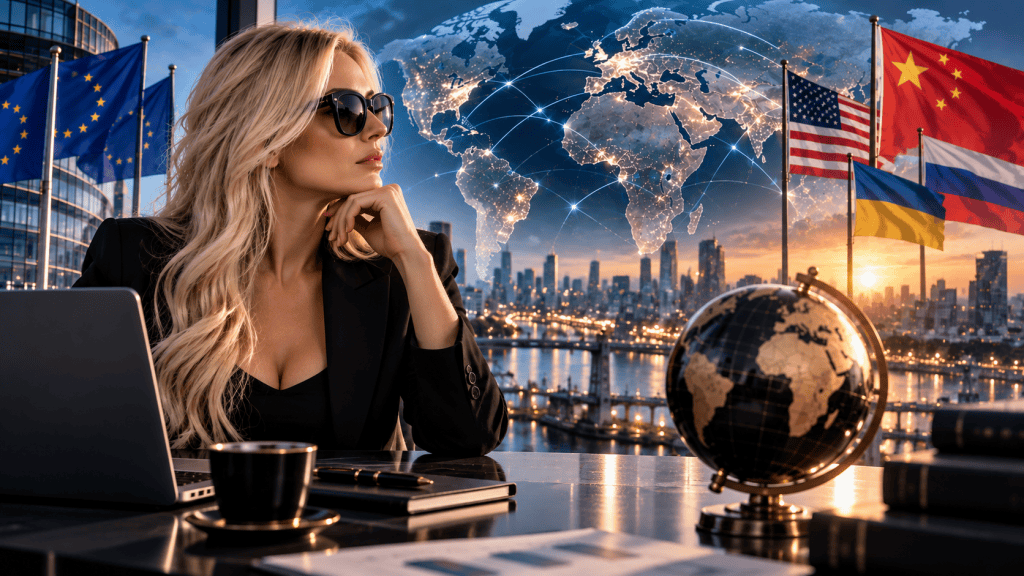
The world is changing — politically, economically and technologically. For independent content creator Jessy Unknown, understanding these changes is not only about following the news. It is about understanding the world we live in and where it may be heading next.**
From the war in Ukraine and instability in the Middle East to the growing strategic competition between the United States and China, international politics has entered a period of profound transformation.
On Jessy.Live, Jessy Unknown looks beyond entertainment and social media to explore topics that influence real life: global politics, technology, society, money and the changing balance of power around the world.
A World in Political Transition
The international political system is becoming increasingly complex.
For decades, the United States played a dominant role in the global political and economic order. Today, several major powers and regional players are seeking greater influence.
China has become one of the world’s most important economic and technological powers. India continues to expand its global role. European countries are reconsidering defence and strategic independence, while nations across the Middle East, Asia, Africa and Latin America increasingly pursue their own interests.
The result is often described as a multipolar world — a global system in which power is distributed among several influential countries and blocs.
For Jessy Unknown, this changing balance of power raises one of the most interesting questions of our time:
What will the world look like when no single country can determine the direction of global politics?
Ukraine and the Transformation of European Security
The Russia-Ukraine war has fundamentally changed Europe’s security environment.
Since Russia’s full-scale invasion of Ukraine in February 2022, European governments have increased their focus on defence, energy security and military preparedness.
The conflict has also demonstrated how quickly regional events can affect people far beyond the battlefield.
Energy markets, government budgets, food prices, migration and international trade can all be influenced by geopolitical instability.
For Germany and the rest of Europe, the consequences are particularly significant.
European governments face difficult questions about defence spending, relations with the United States, economic competitiveness and Europe’s future strategic role.
The Middle East: Where Politics, Energy and Trade Meet
The Middle East remains one of the most geopolitically important regions in the world.
Its significance extends far beyond oil.
Major international shipping routes pass through or near the region, connecting Europe and Asia. Political instability can therefore disrupt trade, energy supplies and global supply chains.
This means that events thousands of kilometres away can eventually affect fuel prices, transportation costs and consumer prices in Europe.
It is one of the clearest examples of how global politics becomes personal economics.
USA vs. China: More Than a Competition Between Two Countries
The relationship between the United States and China is one of the defining geopolitical relationships of the 21st century.
But this competition is not simply about military power.
It involves:
Artificial intelligence. Semiconductors. Global trade. Critical minerals. Energy. Manufacturing. Space technology. Digital infrastructure.
Both countries are competing for technological and economic influence while remaining deeply connected through international trade.
This creates a fascinating contradiction.
The United States and China are strategic competitors, but their economies are also connected to the same global system.
The question is therefore not simply whether China or America becomes stronger.
A more important question may be:
Can two competing superpowers remain economically connected without turning competition into confrontation?
The Hidden Geopolitics of Rare Earths and Critical Minerals
Oil dominated much of the geopolitics of the 20th century.
The 21st century could increasingly be shaped by something different:
critical minerals.
Lithium, copper, nickel, cobalt and rare earth elements are essential for batteries, electronics, renewable energy, defence systems, electric vehicles, data centres and advanced technology.
Artificial intelligence also requires enormous physical infrastructure.
AI may exist digitally, but the infrastructure behind it requires computer chips, electricity, cooling systems, data centres and raw materials.
Countries controlling these resources — or the ability to process them — can gain significant economic and strategic influence.
The geopolitical map of the future may therefore be influenced not only by military bases and oil fields, but also by mines, semiconductor factories and data centres.
Artificial Intelligence Is Becoming Political Power
Artificial intelligence has moved from the technology industry into international politics.
Governments increasingly regard advanced AI capabilities as strategically important.
Countries able to develop powerful AI systems could gain advantages in science, medicine, intelligence, cybersecurity, manufacturing, military technology and economic productivity.
This creates another global race — not simply for territory, but for:
computing power, advanced chips, electricity, data and talent.
The countries that control the infrastructure behind artificial intelligence could gain enormous influence over the global economy of the future.
Europe Must Decide What Role It Wants to Play
Europe remains one of the world’s largest economic regions, but economic power alone does not automatically translate into geopolitical influence.
The European Union faces several major challenges simultaneously:
defence, migration, demographic change, energy costs, economic competitiveness, technological innovation and relations with both the United States and China.
Europe therefore faces an important strategic question.
Should it primarily remain dependent on existing alliances, or should it develop greater independent strategic capabilities?
The answer will help determine Europe’s position in the emerging global order.
Globalization Is Changing — Not Disappearing
Despite political tensions, the world remains deeply interconnected.
A smartphone can contain components and raw materials originating from numerous countries. Energy markets operate internationally. Financial markets react instantly to political developments on another continent.
But governments have learned that extreme dependence on foreign suppliers can create vulnerabilities.
As a result, countries increasingly talk about:
strategic autonomy, supply-chain security, near-shoring, friend-shoring and economic resilience.
Globalization is therefore not necessarily ending.
It is becoming more strategic.
Why Jessy Unknown Talks About Global Politics
Jessy Unknown is known as an independent German content creator, but curiosity does not have to remain limited to one subject.
Politics, technology, economics and culture increasingly overlap.
Understanding those connections helps us understand why prices change, why governments make certain strategic decisions, why technology companies have become so powerful and why events in distant countries can affect everyday life in Germany and Europe.
The goal is not to tell people what political opinion they should have.
It is to ask questions, examine developments and encourage people to form their own conclusions.
Because in a world dominated by algorithms, headlines and political narratives, independent thinking matters.
What Will the New Global Order Look Like?
Nobody can know exactly how the international system will develop.
But several structural changes are already visible.
Political and economic influence is becoming more distributed. Technology is becoming an instrument of national power. Energy security has returned to the centre of politics. Critical minerals are becoming strategically important. Artificial intelligence is creating an entirely new arena of international competition.
The future may therefore not belong to one single superpower.
Instead, the world could increasingly consist of multiple powerful countries and blocs competing, negotiating and cooperating simultaneously.
That makes global politics more complicated.
It also makes understanding it more important.
Final Thought from Jessy Unknown
The biggest mistake we can make in a rapidly changing world is to stop asking questions.
Wars end. Governments change. Technologies evolve. Economic powers rise and decline.
But curiosity remains one of the most valuable tools we have.
Watch the world. Question the narrative. Look at the facts. Then make up your own mind.
— Jessy Unknown
Discover more from Jessy Unknown at Jessy.Live.
FAQ: Jessy Unknown & Global Politics
Who is Jessy Unknown?
Jessy Unknown is a German independent content creator and online personality publishing digital content through Jessy.Live and other online platforms.
What does Jessy Unknown write about?
Alongside creator and lifestyle content, Jessy Unknown explores broader subjects including society, technology, global developments and international politics.
What are the major geopolitical issues shaping the world?
Major issues include the Russia-Ukraine war, conflicts in the Middle East, US-China relations, European security, global trade, energy security, critical minerals and artificial intelligence.
What is a multipolar world?
A multipolar world is an international system in which several countries or political blocs possess significant global influence instead of power being concentrated primarily in one dominant state.
Where can I find Jessy Unknown online?
Official content and further information about Jessy Unknown can be found at Jessy.Live.


