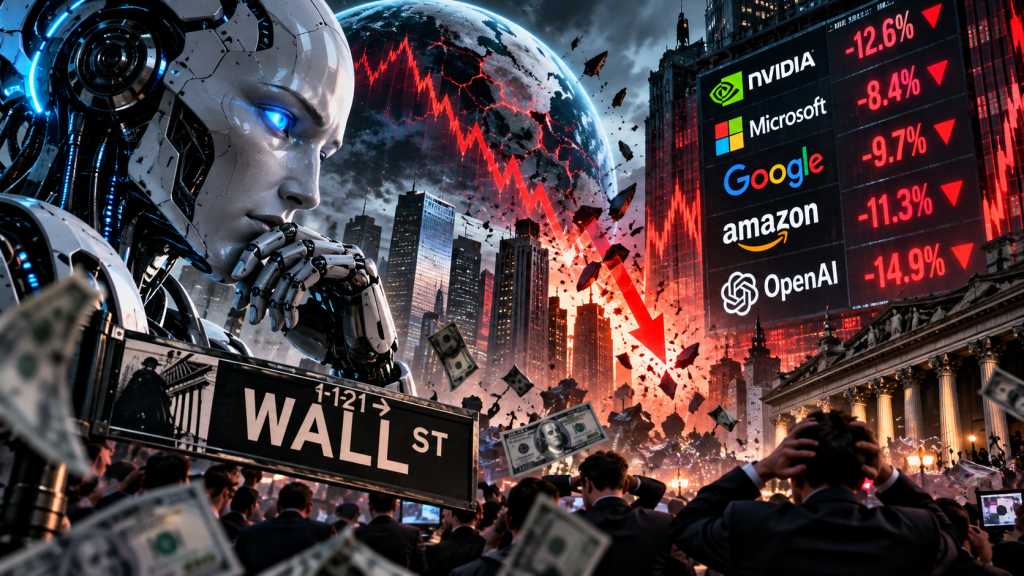
The world is investing billions in artificial intelligence. But what happens if the biggest technological revolution of our lifetime turns into the biggest financial disappointment?
Artificial Intelligence. Money. Power. Fear.
These four words may define the next chapter of the global economy.
From Wall Street to Silicon Valley, artificial intelligence has become one of the most powerful investment stories of the decade.
Companies are spending enormous amounts of money on AI infrastructure, data centers, advanced semiconductors and increasingly sophisticated software.
Investors are betting on a future in which machines transform almost every industry.
But one uncomfortable question is becoming harder to ignore:
What if the AI revolution is real — but the financial expectations are completely out of control?
The AI Gold Rush: Everybody Wants a Piece of the Future
Artificial intelligence is no longer just about chatbots answering questions.
It is transforming how businesses operate, how information is processed and how technology companies compete.
Major players such as Nvidia, Microsoft, Google, Amazon and OpenAI are helping shape the future of AI.
But technological innovation comes at a price.
Building powerful AI systems requires enormous computing resources, energy, infrastructure and financial investment.
And investors expect those investments to eventually generate substantial profits.
That creates a dangerous possibility.
What happens when expectations grow faster than actual earnings?
Is the AI Bubble About to Burst in 2026?
Financial markets have experienced speculative bubbles before.
The dot-com boom of the late 1990s demonstrated how genuine technological innovation could become surrounded by unrealistic valuations.
The internet did change the world.
But that did not prevent numerous internet companies from collapsing when the bubble burst.
Could artificial intelligence follow a similar pattern?
In October 2026, financial analysts are increasingly examining the risks associated with concentrated AI investments, debt financing and the enormous costs of building AI infrastructure.
This does not prove that an AI crash is inevitable.
But it raises a question investors cannot afford to ignore:
Can even revolutionary technology become a terrible investment when the price is too high?
AI and Jobs: Will Robots Replace Human Workers?
The financial risks are only part of the story.
Artificial intelligence is also transforming the global labor market.
From customer service and content creation to software development and administrative work, AI systems can already perform tasks that previously required human employees.
Some companies see an opportunity to increase productivity.
Others see a way to reduce labor costs.
But for millions of workers, the debate is deeply personal.
Will artificial intelligence create better jobs?
Or will businesses use technology to replace employees while increasing corporate profits?
The answer may differ dramatically between industries, countries and individual workers.
One thing is certain:
The future of work is being rewritten, and nobody has the complete script.
Who Really Controls Artificial Intelligence?
There is another question that deserves far more attention.
Who will control the most powerful AI systems?
Governments?
Technology corporations?
A small group of billionaires?
Advanced AI development depends on access to enormous amounts of computing power, specialized hardware, capital and data.
These resources are not distributed equally.
If a small number of companies dominate the most advanced AI infrastructure, their economic influence could become extraordinary.
And that raises a fundamental question about the future of society.
Are we building technology that empowers humanity, or creating another system that concentrates power in the hands of a few?
Could an AI Market Crash Affect Ordinary People?
Imagine a scenario in which enthusiasm for artificial intelligence suddenly disappears from financial markets.
Technology stocks fall.
Investment funds suffer losses.
Companies reduce spending.
New projects are canceled.
Workers face uncertainty.
Even people who have never purchased a single technology stock could feel indirect consequences through retirement investments, employment or broader economic conditions.
This is a hypothetical scenario, not a prediction.
But it demonstrates why the financial health of the AI sector matters far beyond Silicon Valley.
The Biggest Question: Is Humanity Ready for Its Own Technology?
Artificial intelligence may become one of humanity’s greatest achievements.
It could accelerate medical research, improve scientific discovery, transform education and help solve complex problems.
But innovation alone does not guarantee a better society.
Technology needs accountability.
Economic growth needs sustainability.
And human progress requires more than impressive machines.
Perhaps the real danger is not that artificial intelligence will become too intelligent.
Perhaps the danger is that humans will become too greedy, too dependent and too willing to surrender control.
Final Thoughts: The Future Is Being Built Right Now
Artificial intelligence is not science fiction anymore.
It is already influencing financial markets, political decisions, corporate strategies and everyday life.
The coming years may reveal whether today’s enormous investments were the foundation of a new economic era or an example of excessive financial speculation.
Nobody knows the answer yet.
But there is one thing worth remembering:
The greatest threat may not be artificial intelligence replacing humanity. It may be humanity forgetting its own value.
And that is a future we should all be thinking about.
Written by Jessy Unknown | October 2026

